Course Authors
John E. Morley, M.D.
Release Date: 05/07/2002
Upon completion of this Cyberounds®, you should be able to:
Develop a treatment plan for falls in the nursing home
Design a preventive program that includes the use of hip protectors in frequent fallers
Discuss the use of calcium, vitamin D, and bisphosphonates in appropriate nursing home residents.
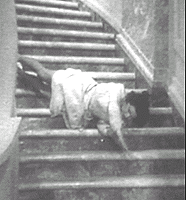
Hip fractures are associated with a 12% to 20% increase in mortality. All fractures have an increased morbidity and in the nursing homes in the USA have become a major activity area for lawyers!
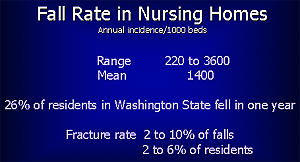
While spontaneous hip fractures occasionally occur, most fractures are secondary to a fall. Falls are extremely common in nursing homes.

In nursing homes and in the community, persons who fall are active. In nursing homes, persons who are chair-bound and fall have higher functional status.

In a person with new onset falls, delirium needs to be ruled out.
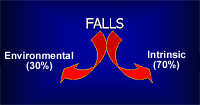
Falls can be due to problems in the environment or problems of the individual's functional status.
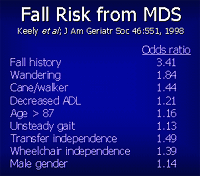
The causes of falls are multifactorial, as shown by this study utilizing the minimum data set (MDS) in nursing homes. The higher the odds ratio, the more likely the variable will predict falls.
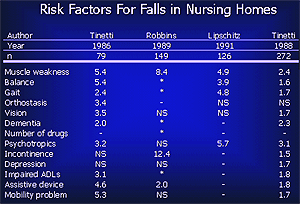
A number of studies have examined the risk factors for falls in nursing homes as demonstrated in this table.
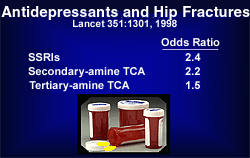
All antidepressants, including selective serotonin reuptake inhibitors (SSRIs), are associated with an increased risk of developing hip fractures.
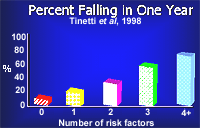
Not surprisingly, the chances of falling increase with the number of risk factors the person has.

The time one can maintain balance on one leg is a major predictor of injurious falls. The odds ratio for one leg balance is 2.13 and the range of odds ratios is 1.04 to 4.34. As the range of odds ratios does not overlap 1.0, this suggests that one leg balance is a good predictor of injurious falls.

"Up and Go" is the time to stand from the sitting position. If it takes longer than 4.5 seconds, it predicts falls. Persons who find it difficult to stand holding a full glass of water are more likely to fall.
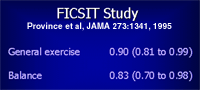
The FICSIT study demonstrated that improving balance appeared to be the most important modality for decreasing falls. The lower the value of the odds ratio, the less likely one is to fall.
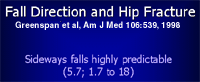
Direct falls on the hip increase the likelihood of fracture. Malnourished older persons have less soft tissue protecting the hip and have an increased fracture rate. Numbers in parentheses refer to mean odds ratio and range.
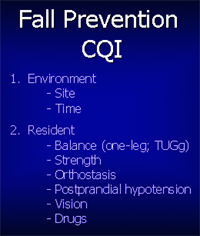
In preventing falls, it is important to pay attention to the factors listed here. Both orthostasis and postprandial hypotension are important modifiable causes of falls.
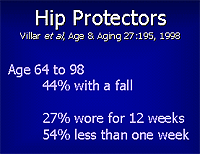
Hip protectors, when regularly worn, decrease fracture rate. The fracture rate decreases to 44% from 100% in persons wearing hip protectors.

Two studies, both of women, show high prevalence of osteoporosis.
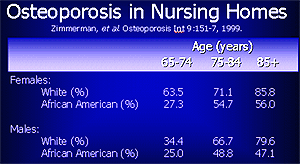
The risk of osteoporosis in African American women is less but, still appreciable. Similarly, many males in nursing homes are osteoporotic.
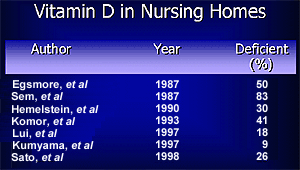
Between 8% and 83% of residents in nursing homes have some degree of vitamin D deficiency.

A low normal calcium level and an increased alkaline phosphatase level are highly predictive of vitamin D deficiency.
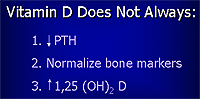
Vitamin D replacement does not always normalize bone mineral metabolism. However, Chapuy's studies in French nursing homes have clearly shown that vitamin D (800 IU) and calcium (1.2 g) intake decreased hip fractures in nursing homes.

Physicians, in general, are unaware of crumbling bones.
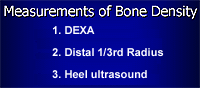
In the nursing home, there is a need for simple measurements of bone mineral density. Heel ultrasound and finger densitometry are good candidates. While DEXA is the gold standard and distal one-third of radius offers high reliability, simple measurements, such as heel ultrasound and finger densitometry, may be more practical.
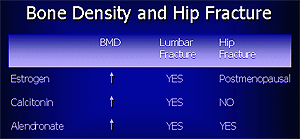
The PROOF study has failed to demonstrate a significant decrease in hip fracture with calcitonin. Calcitonin is analgesic when used to treat vertebral fractures.
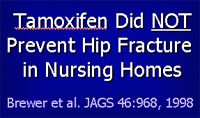
As tamoxifen did not decrease hip fracture, it is unlikely that other selective estrogen receptor modulators, e.g., raloxifene, will prevent hip fractures in the nursing home.

Alendronate prevents hip fracture in the community and has been shown to increase femoral neck bone mineral density in nursing homes. Residronate is another bisphosphonate with similar properties to alendronate: both clinical bisphosphonates can now be given once a week. A once a year bisphosphonate given intravenously is under investigation.
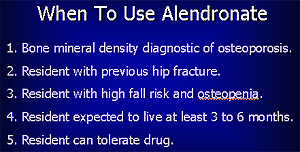
Guidelines for the use of bisphosphonates in nursing homes are being developed. Some factors to be taken into account are given here.
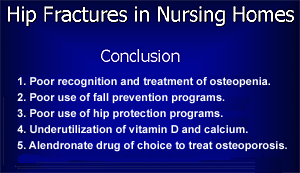
In conclusion, hip fractures in nursing homes are somewhat preventable if the clinician focuses on fall prevention and osteoporosis management.
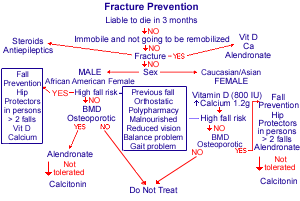
An algorithm is included for the approach to management of falls in a nursing home.