Course Authors
Richard W. Smalling, M.D., Ph.D.
Release Date: 10/30/1996
Cardiovascular disease continues to be the leading cause of death and disability in Western civilization. In the United States alone, approximately 500,000 patients per year succumb to heart attacks. Despite significant reductions in the incidence and mortality from heart disease, it still kills twice as many people as cancer (Figure 1).

Table 1. Deaths in U.S. in 1990 Per 100,000 Population.
| Table Headline | ||
|---|---|---|
| Rate | % of All Deaths | |
| Cardiovascular | 355 | 41 |
| Cancer | 203 | 23 |
| Lung Disease/Pneumonia | 67 | 8 |
| Accidents | 37 | 4 |
| Diabetes | 19 | 2 |
| Suicide | 12 | 1.4 |
| AIDS | 10 | 1.2 |
| Renal Disease | 8 | 1.0 |
CDC Monthly Vital Statistics Report: 1993;41,7 Supplement 1-12.
In this conference we will be looking at the treatment issues surrounding myocardial infarction specifically. For a consideration of diagnostic and treatment issues for a variety of cardiovascular problems in women, take a look at this month's Cyberounds® Women's Health conference, moderated by my Cyberounds® colleague, Dr. Susan Stewart. Both Susan and I are beating the drum for early recognition as a key feature of treatment.
Etiology of Myocardial Infarction: The Unstable Plaque
Heart attacks generally occur in patients with pre-existing atheromatous deposits in their coronary arteries. It is felt that lipid laden plaques become disrupted, exposing their lipid contents to the circulation which then causes platelet activation, thrombus formation and coronary artery occlusion (See Figure 2). Regional myocardial function ceases within seconds after a coronary occlusion; however, irreversible necrosis is delayed for approximately 20-30 minutes. Subsequently, the myocardium develops progressive irreversible damage over the next three to twelve hours depending on the level of regional collateral blood flow.
Figure 2. Figure Headline.
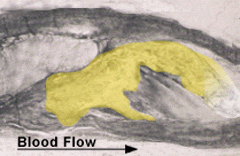
Representation of a coronary artery (longitudinal section) showing plaque (in yellow) which has pushed into the arterial lumen, narrowing it and thereby reducing bloodflow downstream.
The History of Thrombolytic Therapy
Early work by Reimer and Jennings demonstrated this so-called wave-front of myocardial necrosis after coronary occlusion. Subsequently, Theroux and Ross demonstrated that restoration of myocardial blood flow in a dog coronary artery after two hours of occlusion, resulted in recovery of regional function in the infarct and risk region, while dogs which had persistent coronary occlusions did not develop improved function. Thus, the groundwork was laid for interventions designed to restore coronary blood flow in patients with acute myocardial infarction. Rentrop and colleagues showed how an infusion of streptokinase directly into occluded coronary arteries resulted in dissolution of occlusive clots and restoration of blood flow to the ischemic myocardium. This work was extended by investigators throughout Europe and the United States and, ultimately, throughout the world, leading to intravenous administration of thrombolytics in trials which demonstrated conclusively that thrombolytic therapy markedly reduced mortality in patients with acute myocardial infarction. An angiogram in a patient with an acute inferior myocardial infarction with an occluded right coronary artery is depicted in Figure 3. After 75 minutes of intravenous tissue plasminogen activator (t-PA) administration, blood flow was re-established in the artery, as illustrated in Figure 4.
Figure 3. Figure Headline.

Figure4. Figure Headline.

Key Issues in the Treatment of Myocardial Infarction
Over the past 20 years a number of key issues have become apparent regarding restoration of blood flow to ischemic myocardial tissue.
Time to Reperfusion
The MITI (Myocardial Infarction Triage and Intervention Trial) investigators demonstrated that emphasis on treatment should focus on myocardial infarction patients very early in their course. The MITI trial found that treatment with t-PA within 70 minutes of onset of pain resulted in an acute mortality of 1.2 percent, while treatment beyond 70 minutes resulted in a mortality of 8.7 percent, a number strikingly similar to that published in the LATE (Late Assessment of Thrombolytic Efficacy) trial in the treatment arm between 6 and 12 hours after onset of pain. Linderer also showed that patients treated within one and one-half hours after onset of pain experienced a 21-day mortality of one percent, compared to seven percent in patients treated beyond one and one-half hours. Therefore rapid recognition and treatment of myocardial infarction is key in order to optimize outcome.
Completeness of Reperfusion
In addition to the importance of restoration of blood flow, the quality of restored blood flow is a major factor in predicting outcomes as well. Achieving reperfusion without restoration of normal (so called TIMI III flow) flow, in general, does not improve the outcome of patients measured either by mortality or left ventricular function. The relationship between TIMI flow grade and mortality in the GUSTO I (Global Utilization of Streptokinase and t-PA for Occluded Coronary Arteries) angiographic trial was closely correlated. The correlation coefficient between observed and predicted mortality utilizing TIMI III flow status, as the variable was over 0.9. This phenomenon was observed for LV function in the RAPID I (Reteplase Angiographic Phase I International Dose-Finding) trial as well, as illustrated in Figure 5.
Figure 5. Figure Headline.
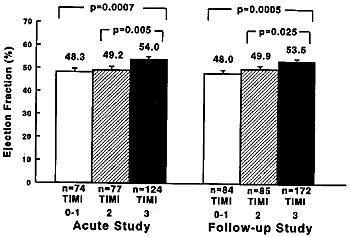
Bar graphs showing acute and follow-up ejection fractions as a function of TIMI grade at 90 minutes after treatment in all patients evaluated angiographically.
Continued Patency
Once thrombolysis is successful, it is important to maintain potency. Multiple investigators have shown an increase in mortality from six percent to 12-14 percent in the acute hospital phase when a reperfused artery undergoes re-closure. It has also been shown that this increased mortality continues to worsen at an accelerated rate in patients with arteries that remain closed over the following year.
Recognizing Acute MI
History
The most common symptom in patients with acute myocardial infarction is chest pain. This may be a retrosternal pressure, squeezing or burning sensation, but also may be epigastric in origin and, occasionally, may originate in the arm or neck. The pain may radiate to either arm or the neck and may be associated with nausea, dyspnea or diaphoresis. There is little or no improvement with either nitroglycerine or antacids. In patients with significant epigastric discomfort that is not relieved by antacids, one should consider the diagnosis of acute inferior myocardial infarction. Epigastric pain (without chest pain) is the most common symptom in patients whose diagnosis of myocardial infarction is missed because an ECG was not ordered.
Physical Examination
Patients with myocardial infarction are often tachycardic and hypertensive with pain. In patients with acute inferior myocardial infarction, the jugular venous pressure may be elevated, signifying acute right ventricular dysfunction. Patients with this finding should not be diuresed, since the right ventricle requires increased filling pressures to move the blood to the left side of the heart for pumping to the systemic vessels. On cardiac exam, the most common finding is an S4 at the apex; however, patients presenting with prolonged pain may suffer mechanical events, such as papillary muscle dysfunction, rupture, or ventricular septal defect. These patients may be expected to have murmurs in addition to the S4. The presence of rales, and/or shock, suggests a poor prognosis which would best be treated by aggressive interventional therapy, including left ventricular assistance, catheterization and PTCA (Percutaneous Transluminal Coronary Angioplasty) or bypass surgery. Obviously, the presence of symmetrical pulses is important, since dissection of the aorta is an important differential diagnosis in patients with chest pain.
12-Lead Electrocardiogram
The key diagnostic test for patients with chest pain is a 12-lead electrocardiogram. While some patients will not have significant ECG findings, those with an injury pattern present on an electrocardiogram, particularly with reciprocal changes in the anatomically opposite leads (See Figures 6 and 7), the diagnosis of acute myocardial infarction is virtually certain.
Figure 6.

Figure 7.

An injury pattern, or ST elevation, in any two adjacent leads in the precordial segments (e.g. V3 and V4, V4 and V5, etc) is consistent with an anterior myocardial infarction, usually involving occlusion of the left anterior descending coronary artery. Occasionally the injury pattern will extend from the V leads to I and AVL, a so-called anterolateral myocardial infarction. Another common site of injury is in leads 2 and 3, or 3 and aVF, or 2, 3 and aVF, reflecting electrical activity on the inferior surface of the heart, typically occurring with occlusion of the right, or circumflex, coronary arteries. An electrocardiogram obtained from a patient with an anterior myocardial infarction, is illustrated in Figure 8, and an electrocardiogram from a patient with an inferior myocardial infarction is illustrated in Figure 9.
Figure 8. Acute Anterior MI.

Figure 9. Acute Inferior MI.

The differential diagnosis of acute myocardial infarction includes pericarditis, which is typically associated with pleuritic pain, worse when the patient is supine and improved when the patient sits up and leans forward. Pericarditis is associated with diffuse ST segment elevation, (and PR segment depression) rather than localized, anatomically restricted ST elevation (Figure 10). Pulmonary embolization is also a consideration, but the most frequent electrocardiographic finding in pulmonary embolism is sinus tachycardia. Patients with aortic dissection frequently have asymmetric pulses and the electrocardiogram is generally within normal limits.
Figure 10. Acute Pericarditis.

Adjuncts to Diagnosis
The electrocardiogram is not diagnostic in up to 60 percent of patients with acute myocardial infarction. These patients may have ST segment depression with chest pain, or, particularly in the presence of circumflex occlusion, may have no significant ECG findings. New enzyme markers, such as CK isoforms and troponin T and I, as well as myoglobin, may assist in quickly diagnosing patients who might benefit from thrombolytic therapy, but who have non-diagnostic electrocardiographic findings.
Controversies in the Treatment of Myocardial Infarcation
Which Thrombolytic?
The early TIMI studies demonstrated that tissue plasminogen activator (t-PA) achieved infarct related coronary artery patency more frequently, and earlier, than patients receiving intravenous streptokinase. This has been reaffirmed by the GUSTO I investigators with the angiographic substudy. Despite the fact that tissue plasminogen activator appears to achieve more rapid and complete thrombolysis than streptokinase, the mortality benefit of t-PA compared to streptokinase is not striking. Although t-PA seems to be a better thrombolytic than streptokinase in terms of coronary patency, in certain patient subsets it is also associated with an increased risk of intracranial bleeding, which may offset its overall benefit.
Newer, third generation thrombolytic agents have been developed and have entered clinical trials. The agent which has been most extensively evaluated to date is recombinant plasminogen activator, or reteplase (r-PA). This agent appears to achieve infarct related artery patency approximately 30 minutes earlier than t-PA, and achieves normal, or TIMI III, flow in a greater percentage of patients (see Figure 11).
Figure 11.

Bar Graph A, 90-minute patency rate in patients treated with tissue-type plasminogen activator (t-PA), 15-MU single-bolus recombinant plasminogen activator (reteplase, r-PA), 10+5-MU double-bolus r-PA, and 10+10-MU double-bolus r-PA.

Bar Graph B, TIMI 2 and 3 patency rates at hospital discharge.
The patency trials comparing this agent to t-PA have not demonstrated an increased risk for bleeding complications. A larger trial, comparing r-PA to streptokinase, suggested a trend toward improved survival without significant increased morbidity, particularly with regard to intracranial bleeding. A larger trial comparing r-PA to t-PA is underway (GUSTO III) and, hopefully, will be complete by this Winter or early Spring.
PTCA versus Thrombolysis
Another controversial area in treatment of acute myocardial infarction is whether or not direct coronary angioplasty for acute myocardial infarction is superior to thrombolytic therapy. The PAMI (Primary Angioplasty in Myocardial Infarction) and Zwolle investigators have suggested that direct coronary angioplasty is a far preferable approach in terms of left ventricular function, with a trend toward improved survival and a reduced incidence of intracranial bleeding. The GUSTO II-b trial, however, did not produce such a dramatic result in a larger number of patients. This conflicting information may represent the substrate of cath labs evaluated in these trials. The GUSTO investigators encompassed a larger, more diverse group of hospitals and investigators, while the PAMI and Zwolle investigators tended to work in high volume, acute care centers. It is also possible that the inclusion criteria in the GUSTO study were less restrictive.
It is accepted, however, that patients with large anterior myocardial infarction with heart failure and/or left ventricular dysfunction, and subsequent hemodynamic instability, benefit more from acute intervention than thrombolysis. The mortality in patients treated conservatively in the presence of pulmonary edema, or cardiogenic shock, approaches 80 percent. Thrombolysis reduces that mortality to only 60-70 percent, while direct angioplasty in association with intra-aortic balloon counter-pulsation and/or bypass surgery, reduces the mortality to 35-50 percent.
Summary
Key features for the treatment of acute myocardial infarction include early recognition of the condition by both the patient and the treating institution. The public needs to be educated to call 911 immediately (in the US) when symptoms of chest pain develop. It will probably be important for paramedic ambulance units to incorporate 12-lead ECG machines capable of transmission of these electrocardiograms to receiving hospitals in order to facilitate early treatment. Ultimately, administration of thrombolytics in the field may routinely occur, given the favorable results achieved in Europe and Israel with this form of therapy.
Patients presenting with hemodynamic instability and/or pulmonary edema appear to benefit from direct coronary angioplasty with intra-aortic balloon counter-pulsation and, on occasion, coronary bypass surgery. There is no clear advantage for PTCA over thrombolysis at the present time, in the absence of hemodynamic instability. It is possible, however, that patients with large anterior infarcts should be considered for acute angiography to confirm successful thrombolysis with adjunctive PTCA and/or coronary stenting if flow in the infarct related artery is not adequate. Newer, third generation, thrombolytics may offer advantages in terms of ease of administration as well as more rapid and complete flow restoration.
In the coming months I hope to cover additional topics for the treatment of acute myocardial infarction. For this first cardio conference and for all those in the future, I welcome your questions, comments and suggestions. Topics currently being planned include the current status of mitral and aortic valvuloplasty, the proper evaluation of children with heart murmurs, new ablation therapy for cardiac arrhythmias, current concepts of medical and surgical therapy for heart failure, as well as management of peripheral vascular disease in patients with non-healing wounds.