Course Authors
Morgan Campbell, M.D.
Release Date: 07/13/2000
Upon completion of this Cyberounds®, you should be able to:
Describe the role of t-PA in acute ischemic stroke and the need to treat stroke as a true neurologic emergency
Discuss potential acute stroke treatments undergoing study
Discuss the use of aspirin and other antiplatelet agents in secondary stroke prevention.
Please welcome Dr. Morgan Campbell to the Cyberounds® family. Dr. Campbell has joined us after training in Interventional Neurology at the University of Birmingham. He is now an integral part of a team headed by Dr. Jim Grotta, in conjunction with the Houston Department of Emergency Services which coordinates and facilitates the care of stroke patients citywide in Houston. This team approach greatly improves patients' chances for receiving state of the art treatment for their "brain attacks". The emergency treatment of stroke patients is now developing along similar lines which have evolved for the treatment of heart attack patients and promises to significantly improve the outcome in patients who have been previously condemned to death or serious disability. I am sure you will enjoy this update on stroke therapy.
-- Richard W. Smalling, M.D., Ph.D., Cardiovascular Moderator
Stroke affects 700,000 people annually in the U.S. and is the third leading cause of death and the number one cause of long-term adult disability. The search for better treatment options and secondary prevention measures has received heightened interest in the last several years with the advent of thrombolytic therapy for acute stroke treatment. The following discussion highlights the currently evolving research and treatment options for the patient who presents with stroke or transient ischemic attack.
Intravenous Thrombolysis
The approval of t-PA in June 1996, based on the results of the National Institute of Neurological Disorders and Stroke (NINDS) t-PA Stroke Trial, was a major advancement in stroke management. This treatment for acute stroke offered new hope for a condition often approached with a nihilistic attitude. The Stroke Trial demonstrated that, with early presentation, diagnosis and treatment, a favorable benefit could be achieved in acute ischemic stroke patients.(1) In the NINDS t-PA Stroke Trial, patients given intravenous t-PA within a three-hour time window of ischemic stroke onset showed a statistically significant benefit in the three-month outcome measures of functional independence. Patients were selected by carefully predefined inclusion and exclusion criteria including blood pressure levels and treatment parameters. Phase IV data collected on post-trial t-PA use have indicated similar favorable clinical outcomes. Three years later, however, it is estimated that only 1-2% of ischemic stroke patients are treated with thrombolysis. In centers with well organized stroke teams, up to 10-20% of all stroke patients could potentially be treated. Only a small increase in the total usage of t-PA over the NINDS trial study period has been seen, with the biggest barrier to treatment being not screening and treating patients within the three-hour time window.(2),(4)
Since publication of the trial, the medical community has been faced with a new challenge of now viewing stroke as a true neurologic emergency. Changing long standing beliefs and attitudes has proven to be a difficult and often frustrating task. Extensive efforts are needed to educate medical professionals, from physicians to EMS personnel, as well as efforts at educating the public in stroke awareness. Indeed, perhaps the most important result of thrombolytic approval is the new focus on acute stroke as an emergency with a critical time window to treatment.(5) Analogous to acute myocardial infarction and early treatment, "time is brain". Even within the three-hour time window for treatment with intravenous t-PA, time to treatment affects the ultimate outcome in stroke therapy. Hospital and EMS triage is being re-thought to develop algorithms for acute stroke evaluation and treatment that are time focused.
These ongoing efforts of many emergency rooms and stroke treatment centers require a multidisciplinary physician support network involving emergency medicine, primary care, neurology and radiology to be successful in implementation. As therapies evolve, the effective time window for acute stroke treatment will likely extend to six hours (or possibly beyond) but, in all cases, the anthem of "time is brain" will follow and earlier treatment will lead to better patient outcomes. Having systems in place for the rapid evaluation and treatment of stroke patients will be crucial to the success of future trials and will become the standard of care for acute neurologic ischemic events.
In the European Cooperative Acute Stroke Study thrombolytic trials (ECASS I and ECASS II), a six hour treatment window for IV thrombolytics was used. ECASS I failed to show statistical significance by intention to treat analysis for the primary outcome measures.(3) In ECASS II, a trend to benefit was shown but, again, the pre-defined primary outcome measure did not reach significance.(6) In both trials, this trend toward favorable outcome was present despite an increase in the rate of symptomatic intracerebral hemorrhage (ICH) in treated patients which was similar in both the 0-3 hr. and 3-6 hr. treatment groups. The NINDS trial also showed a significant increase in symptomatic ICH in treated patients (7% vs. 1%) with the net benefit of treatment still remaining. No significant differences in mortality rates were noted between the groups.(7),(8)
In a meta analysis, combing all three trials, using the favorable outcome of functional independence defined as modified Rankin score of 0,1 or 2, the chance for independence with t-PA was 37% greater, despite a threefold increase in the rate of ICH. This data suggest that carefully selected patients given t-PA within a six hour time window continue to show a net benefit of favorable outcome with the chances of favorable outcome being even greater for those patients treated within the first three hours. Pilot studies are now ongoing in academic medical centers using intravenous t-PA within a three to six hour time window to test this hypothesis.
Intra Arterial Thrombolysis
Intra arterial thrombolysis continues to receive interest and offers the potential benefits of tailored dosing, combination with mechanical clot ablation, concurrent anticoagulation and better prevention of re-occlusion (See example in Figure 1).

Figure 1. Acute Stroke Thrombolysis.
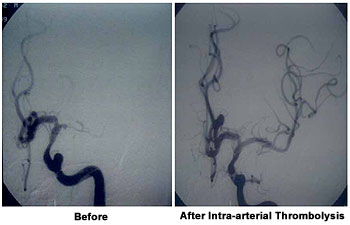
Cerebral angiography in the AP view reveals a left middle cerebral artery occlusion from presumed cardiac embolus in a patient with chronic atrial fibrillation. Intra arterial thrombolysis, combined with mechanical clot disruption, resulted in successful flow restoration.
The PROACT II trial evaluated the use of intra-arterial prourokinase for acute middle cerebral artery (MCA) occlusion treated within six hours.(9) A significant benefit in favor of treatment with prourokinase was shown, despite an increase in intracerebral hemorrhage complications (10% vs. 2%). Two thirds of treated patients achieved TIMI 2 or 3 flow (sluggish or normal blood flow in the infarct related artery), and those treated with prourokinase had a 60% greater chance of minimal or no neurologic disability at three months. Mortality between the two groups was the same (25% vs. 27%). The median time to treatment initiation was 5.3 hours.
A drawback of intra arterial therapy is the additional time and expense required to mobilize an angiography team or to transfer a patient to a center that can offer such therapy. Higher rates of vessel recanalization may be negated by the increased time to treatment inherent with an interventional procedure. Despite the significant benefit shown for prourokinase, a confirmatory randomized trial of prourokinase will be needed before approval.
In an attempt to bridge the time gap, the Emergency Management of Stroke (EMS) Trial looked at combined intravenous and intra arterial t-PA for acute ischemic stroke.(10) In this trial, IV thrombolytic was given within three hours of stroke onset, followed by angiography and intra arterial t-PA administration if residual clot was found. Although only a pilot study with small patient numbers (35), a trend toward higher rates of recanalization and favorable three-month stroke outcomes were seen. A phase II study supported by the NIH will soon be starting.
Despite considerable research into neuroprotective agents, all trials to date have met disappointing results. It is likely that part of the failure of such trials is inadequate delivery of agents to the site of ischemic compromise. Lack of perfusion to the ischemic territory prohibits neuroprotective drug from reaching this very same target site. In the future, thrombolysis to achieve perfusion combined with intravenous or selective intra arterial delivery of a neuroprotective drug may hold the key to finding a successful agent.
Endovascular Rescue
Endovascular therapy (emergency cerebral angiography with angioplasty and/or stenting of the culprit lesion) is a promising new approach currently being explored at highly specialized centers as a research tool in aggressive acute stroke management (See Figure 2).
Figure 2. Acute Stroke Angioplasty and Stenting.

Angiography of the left vertebral artery in the lateral view demonstrates a distal vertebral and basilar artery occlusion beginning at the level of the C1 vertebral body. Approximate time interval from stroke onset was ten hours, making the use of thrombolytics contraindicated. Angioplasty followed by stenting of the distal vertebral artery was used to restore flow to the vertebrobasilar system. The etiology for this stroke was most likely focal atherosclerotic occlusion of the terminal left vertebral artery, which was opened with angioplasty and stent placement.
This approach offers the theoretical advantage of restoring flow to ischemic tissue without the bleeding risk associated with thrombolytic therapy. It offers hope to those patients outside the time window or with contraindications to thrombolytics, such as those who are post operative or severely hypertensive. These techniques, essentially, expand on the technology and experience of interventional cardiology and primary angioplasty for acute MI applied to a new vascular territory, namely that of the cerebral vasculature.
As the technology continues to expand, devices specifically developed for the cerebral vasculature will come into evaluation and use. While, at present, pilot studies exist in only a few medical centers across the country, aggressive vascular neurologists, working along with interventional cardiologists, interventional radiologists and interventional neurosurgeons, will assure the continued development and expanding role of endovascular therapy. Techniques include mechanical clot disruption with microcatheters, angioplasty and even stenting in some cases of atherosclerotic vascular occlusive disease. Other techniques include the use of embolectomy devices, such as photoacoustic or ultrasonic ablation catheters that employ the energy of sound waves to disrupt clots. Rheolytic catheters used in interventional cardiology, such as the angiojet, have been tested in large vessel cerebral arterial and venous occlusions. The ongoing development of these specialized catheters, with designs which more readily cross the tortuous and delicate vessels of the distal cerebral vasculature, will allow future testing of a host of new devices in management of the acute stroke patient.
Anti Platelet Therapy
The mainstay of secondary stroke prevention, aside from risk factor modification, such as hypertension, cholesterol treatment and diabetes control, has been antiplatelet therapy. Antiplatelet therapy is recommended as secondary stroke prevention for patients with transient ischemic attack (TIA) or thromboembolic stroke not of cardiac origin. Several newer antiplatelet agents now exist and the choice of best agent is frequently a matter of debate, based on physician opinion of efficacy, side effects, costs and availability.
Aspirin is the oldest and most studied antiplatelet medication and is still the most frequently prescribed. Aspirin had demonstrated efficacy in secondary stroke risk reduction and is the standard to which newer antiplatelet medications are compared. The best dosage of aspirin has long been a subject of debate among neurologists. No single trial has established the optimal dose of aspirin for the secondary prevention of vascular events. However, a meta-analysis of the trials employing different dose ranges strongly suggests that the benefit of aspirin appears independent of dosage.(11)
The Antiplatelet Trialists' Collaboration (APTC) performed a meta-analysis of the aspirin trials using the outcome measure of vascular events, defined as stroke, myocardial infarction and vascular death. A second meta-analysis, performed by Albers et al, using a slightly different set of aspirin trials, found a similar result.(16) Lower dose aspirin (50-325 mg/d) is now generally recommended, based on the better side effect profile of smaller daily doses. Based on this combined data, aspirin offers a relative risk reduction for vascular events in patients with prior TIA or stroke of 13-22%, depending on the specifics of the defined population or endpoints used.
Three antiplatelet agents have been directly compared to aspirin in large randomized clinical trials and have shown equal or greater clinical efficacy. However, a lack of direct comparison among these new agents makes choosing the best alternative agent difficult. Ticlopidine, clopidogrel and aspirin plus extended-release dipyridamole have all shown efficacy in secondary stroke prevention(12),(14),(15) Each of the respective studies was designed differently with different inclusion and exclusion criteria. The absolute rates of secondary events were also different among the trials. The relative risk reductions compared to aspirin for each trial are noted in Figure 3.
Figure 3. Efficacy of Antiplatelet Agents.
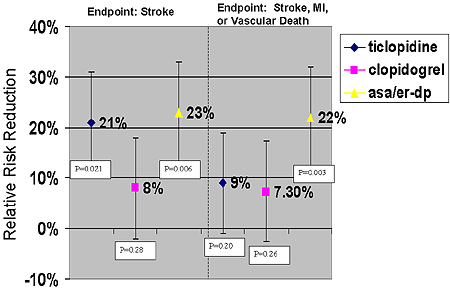
Efficacy of newer antiplatelet agents relative to aspirin from the results of randomized clinical trials. Relative risk reductions for ticlopidine are based on results of the Ticlopidine Aspirin Stroke Study (TASS). Relative risk reductions for clopidogrel are based on results from the stroke subgroup of the Clopidogrel versus Aspirin for Prevention of Ischaemic Events (CAPRIE) trial. Relative risk reductions for asa/er-dp are based on results of the European Stroke Prevention Study 2 (ESPS-2). MI = myocardial infarction, asa/er-dp = aspirin plus extended release dipyridamole.
However, direct comparisons between agents is not possible.
While ticlopidine was shown to be more effective than aspirin, it has a high side effect profile, including a low incidence of severe neutropenia and thrombotic thrombocytopenic purpura.(13) Thus, with the introduction of clopidogrel, ticlopidine fell out of favor. In the clopidogrel trial, the patient subgroup with prior stroke showed risk reduction but not to a statistically significant greater degree than aspirin.(14) If one looks at the entire spectrum of vascular patients and vascular outcomes, clopidogrel's beneficial effects are comparable to that of ticlopidine's.
Because ticlopidine and clopidogrel are both theinopyridine compounds, some might argue that clopidogrel is likely equivalent in efficacy but with a much lower side effect profile. Others might then propose that the data on the theinopyridines can be combined.(17),(18) This is, obviously, a leap in faith in extrapolating the data because of the aforementioned differences in trial design and lack of direct comparison data.
Aspirin plus extended release dipyridamole (Aggrenox®) is the newest antiplatelet combination which clearly reduces the risk of secondary stroke and vascular events. It is the only antiplatelet agent shown to be better than aspirin alone for stroke prevention in the latest European Stroke Prevention Study (ESPS-2).(15) Though previous trials of dipyridamole have met with mixed results, Aggrenox® recently received approval in the U.S. and will likely become the favored agent for secondary stroke prevention, if side effect profiles remain low in post trial usage.
The concept of using double antiplatelet coverage for secondary stroke prevention to achieve a synergistic response in platelet inhibition is a relatively new idea among neurologists but anecdotal experience from stroke neurologists, animal studies and clinical data support the synergistic response of combined antiplatelet therapy.(20),(21),(22) The use of combination antiplatelet agents by cardiologists for patients undergoing coronary stenting has shown benefit in preventing secondary complications.(23),(24),(25),(26),(27),(28) The combination of aspirin with ticlopidine or clopidogrel has also been used with favorable result after carotid artery stenting.
Platelet aggregation studies demonstrate a varying response to aspirin in patients as a group and within individual patients over time. (The addition of a second agent results in a higher and more consistent level of platelet inhibition. The ACCP Consensus Conference in 1998 stated that the complementary mechanism of action of combination aspirin and clopidogrel may produce additive antithrombotic effects in high risk patients with an acceptable safety margin.(19) At present, no long term comparisons of combination aspirin and clopidogrel have been done but the preliminary evidence is intriguing and argues for further study.
Summary
Intravenous t-PA is a proven treatment for acute ischemic stroke if given within the first three hours of symptom onset. Successful outcomes depend on the rapid presentation, evaluation and treatment of stroke patients. To achieve these goals, a higher level of awareness, for both medical professionals and patients, is needed. New acute stroke therapies, currently under research, will depend on this model of treating stroke as a neurologic emergency. Antiplatelet therapy is effective in secondary stroke prevention. Combined aspirin plus extended release dipyridamole has clearly been shown more effective than aspirin alone in secondary prevention and is a new treatment option. Further study of antiplatelet regimens may lead to combination therapy, the new standard in secondary prevention.